AI Regulations: Global Compliance Framework
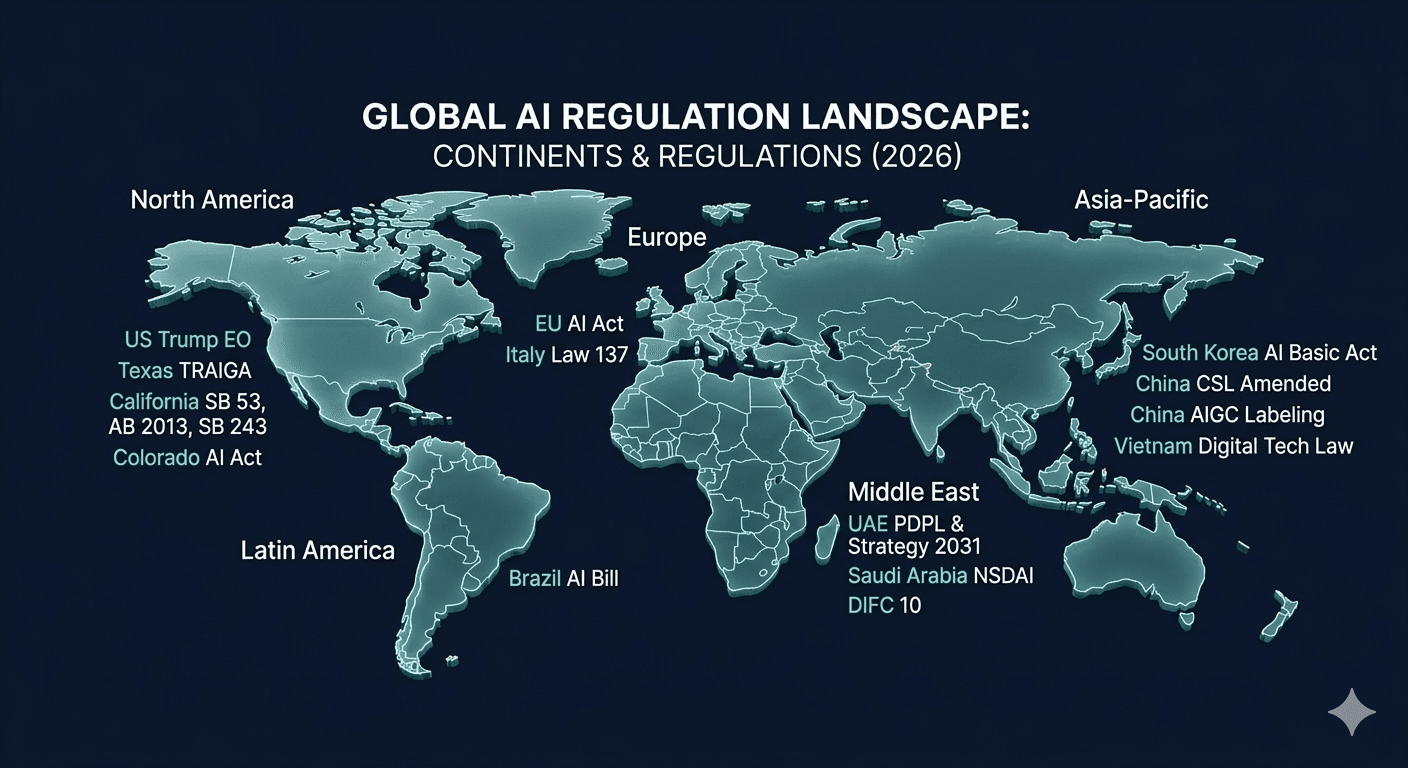
Artificial Intelligence is everywhere, transforming how work is done across industries worldwide. Though still in early stages, AI's potential to become a game-changing technology is immense. As AI usage in workplaces has increased, governments and regulatory bodies have begun creating compliance requirements for organizations.
Leaders globally recognize AI's potential to enhance performance and productivity. However, they're equally concerned about shadow AI risks that can damage reputation and result in compliance fines.
CISOs and compliance officers face immense pressure to establish regulatory frameworks compliant with AI acts while maintaining workflow efficiency. Adopting AI responsibly and in a compliant manner has become essential, leading to widespread AI governance adoption.
As a team leader, your first step is understanding AI regulations and what they require from you. This article provides a clear overview of global AI regulations in 2026.
Middle East
AI regulations in the Middle East have been enforced this year. These acts require companies to consider ASO appointments, AI system registers, and regular assessments for every system processing personal data.
Personal Data Protection Law (PDPL) + AI Strategy 2031
Country: UAE
Effective Date: Ongoing (2021+)
Status: Enforced
Risk Level: High
Penalties: PDPL penalties per violation
The UAE PDPL (2021) ensures personal data is collected, stored, and used lawfully and securely, giving individuals rights over their information. It works alongside AI Strategy 2031, which promotes AI innovation in healthcare, education, and transport, aiming to add $96 billion to the economy by 2030 through safe, ethical AI.
National AI Strategy + PDPL
Country: Saudi Arabia
Effective Date: Ongoing
Status: Active
Risk Level: Medium
Penalties: PDPL enforcement active
Saudi Arabia's National AI Strategy (NSDAI) aims to make the Kingdom a global AI leader by 2030. The strategy promotes investments in tech, startups, and training 20,000 experts while ensuring AI development and usage is safe, ethical, and respects privacy.
DIFC 10 Regulations
Country: UAE
Effective Date: Sep 1, 2023
Status: Active
Risk Level: High
Penalties: Administrative fines
DIFC 10 is a data protection law enforced in 2023 mandating rules for companies in DIFC using AI, machine learning, or similar self-operating tools to process data. Companies must inform users if AI handles personal data. For high-risk data processing, strict rules apply and companies must appoint an Autonomous Systems Officer (ASO) to monitor AI use.
If you operate in the Middle East and are concerned about team AI usage, SilentGuard helps make AI usage visible and controlled.
Asia-Pacific
AI Basic Act (Framework Act on AI Development & Trust)
Country: South Korea
Effective Date: Jan 22, 2026
Status: Enforced
Risk Level: High
Penalties: Fines up to ₩30M (~$21K) per violation. 1-year grace period before enforcement. MSIT can order service suspension.
The AI Basic Act, enforced in January, aims to promote trust in AI systems and safeguard citizens' rights. It follows a risk-based approach, focusing on high-impact AI applications in healthcare, energy, public services, transport, and education. Organizations must notify users when AI is used and establish AI ethics teams to monitor responsibilities and governance.
Amended Cybersecurity Law (CSL)
Country: China
Effective Date: Jan 1, 2026
Status: Enforced
Risk Level: Critical
Penalties: Up to ¥50M or 5% of previous year turnover (10x increase). Personal liability up to ¥1M. Business suspension/closure possible.
China's Amended Cybersecurity Law updates existing laws with increased penalties and stricter regulation on data and app operations. Organizations must secure systems, protect user data, and prevent cyber risks, especially with sensitive information. The law applies to all companies with operations in China, with expanded extraterritorial scope affecting foreign organizations.
If you operate in China, your AI tools are now within CSL scope. Ensure regulated data isn't exposed through employee AI usage—this is where SilentGuard provides the visibility and control needed to prevent penalties.
AI-Generated Content Labeling Measures
Country: China
Effective Date: Sep 1, 2025
Status: Enforced
Risk Level: Medium
Penalties: Compliance fines, business suspension, permit revocation
This act requires companies in China to clearly label any AI-generated content, including text, images, and videos. Users must know content isn't human-created, meaning organizations must add visible labels or tags to AI-generated content. This helps prevent misinformation and deception by making AI usage more transparent.
Generative AI Services Management Measures
Country: China
Effective Date: Aug 15, 2023
Status: Enforced
Risk Level: High
Penalties: Compliance fines, business suspensions, regulatory investigations, permit revocation
These measures ensure AI tools like ChatGPT and Claude are safe, reliable, and follow local laws. Companies must use AI responsibly and keep it safe for users. AI must not break Chinese laws—no misleading information, violence, or content disrespecting socialism.

Law on Digital Technology (AI Provisions)
Country: Vietnam
Effective Date: March 1, 2026
Status: Enforced
Risk Level: High
Penalties: Under development
Vietnam's first law on AI balances technology with risk control. It requires AI usage to be safe, ethical, and transparent while strictly banning AI manipulation. The law takes a human-centric approach to AI tool usage.
PDPA + AI Advisory Guidelines + IMDA Agentic AI Framework
Country: Singapore
Effective Date: Ongoing (2024-2026)
Status: Active
Risk Level: Medium
Penalties: PDPA fines up to S$1M per breach
Singapore's AI framework focuses on safe, responsible, and ethical AI system usage while ensuring proper personal data handling. Companies must inform people how their data is used in AI, making AI-decision transparency essential to how decisions affect individuals.
Digital Personal Data Protection Act (DPDP Act)
Country: India
Effective Date: 2025-2027 (phased)
Status: Phased rollout
Risk Level: High
Penalties: Up to ₹250 crore (~$30M) fines for non-compliance
The DPDP Act protects personal information online for anyone whose data is collected online. It gives users more control over their data—businesses must obtain consent before using user data.
AI Promotion Act
Country: Japan
Effective Date: June 2025
Status: Active (non-binding)
Risk Level: Low
Penalties: No binding penalties. Voluntary compliance expected.
This soft law focuses on AI promotion rather than strict penalties. It aims to promote innovation and boost international competitiveness while encouraging organizations to follow guidelines and act responsibly.
Protection of Critical Infrastructure (Computer Systems) Ordinance
Country: Hong Kong
Effective Date: Jan 1, 2026
Status: Enforced
Risk Level: High
Penalties: HK$500K to HK$5M fines + daily penalties for continuing breaches
This ordinance targets organizations in key sectors—energy, banking, and transportation—requiring them to secure computer systems against cyberattacks. Organizations unable to manage risks face heavy non-compliance fines.
Europe
EU AI Act - High-Risk Systems (Annex III)
Region: Europe (All members)
Effective Date: Aug 2, 2026
Status: In Force (phased)
Risk Level: Critical
Penalties: Up to €35M or 7% global turnover
Annex III identifies AI usage requiring strict control due to potential impact on people's lives. It identifies high-risk AI uses that threaten safety, health, and basic rights. These are allowed but require strict compliance. Main categories include:
- Biometric identification
- Education and training
- Employment & HR
- Access to essential services
- Law enforcement
- Migration, asylum & border control
- Justice and democratic processes
The act applies to both AI providers and organizations of any size or sector. If you fall under Annex III, you must maintain strict compliance, detailed documentation, continuous monitoring, and human oversight. Systems must be registered in the EU database and designed for user transparency regarding decision-making. For customers, this means greater transparency in AI-based decisions affecting daily life.
EU AI Act - Prohibited Practices
Region: Europe (All members)
Effective Date: Feb 2, 2025
Status: Enforced
Risk Level: High
Penalties: Up to €35M or 7% global turnover
This act identifies AI systems posing 'unacceptable risks'—prohibited practices protecting people's safety and fundamental rights. Prohibited practices include:
- Manipulative/deceptive techniques
- Exploitation of vulnerabilities
- Social scoring
- Predictive policing
- Emotion recognition
- Certain real-time biometric identification
Law enforcement agencies have limited exceptions (terrorist threats, missing persons searches). In all other cases, these banned AI categories cannot be deployed.
Organizations must monitor their AI inventory for prohibited practices and withdraw any such systems from the market. Non-compliance leads to massive financial penalties and reputation loss.
If employee-used AI tools fall into this category, they must be removed immediately. Use SilentGuard to identify and manage AI usage across your team.
EU AI Act - GPAI & Transparency
Region: Europe (All members)
Effective Date: Aug 2, 2025
Status: Enforced
Risk Level: Medium
Penalties: Up to €35M or 7% global turnover
This regulation addresses General Purpose AI (GPAI) models and requires transparency from providers. Companies using GPAI must disclose its use while providers must publish detailed summaries of training data, energy use, and system capabilities. This ensures organizations can audit AI tool safety and compliance before deployment.
EU AI Act - Limited Risk (Transparency Requirements)
Region: Europe (All members)
Effective Date: Feb 2, 2025
Status: Enforced
Risk Level: Medium
Penalties: Up to €35M or 7% global turnover
This category covers AI systems interacting directly with people but posing limited risk. Requirements include:
- Informing users when interacting with AI
- Clear disclosure of AI-generated content
- Human oversight and intervention options
- System monitoring for performance issues
Americas
US State-Level AI Regulations
Region: United States
Status: Emerging
Risk Level: Medium
The US lacks federal AI legislation but individual states are implementing requirements. Colorado has passed an AI transparency law. California, New York, and other states are developing frameworks. Companies should prepare for fragmented compliance across states.
AIDA (Artificial Intelligence and Data Act)
Country: Canada
Effective Date: Under development
Status: Proposed
Risk Level: High (when enacted)
Penalties: Expected similar to GDPR
Canada's proposed AIDA would require companies to conduct impact assessments for high-risk AI systems, maintain detailed records, and enable user access to decisions affecting them. It applies to organizations worldwide serving Canadian users.
Brazil's Bill 2338/2023
Country: Brazil
Status: Under discussion
Risk Level: Medium
Expected Penalties: Similar to GDPR
Brazil's proposed AI bill focuses on transparency, accountability, and human rights protection in AI systems. Once enacted, companies will need governance frameworks and impact assessments for AI affecting Brazilians.
Latin America
Several Latin American countries are developing AI governance frameworks:
- Mexico: Developing digital rights protections with AI implications
- Chile: Proposing AI regulation emphasizing transparency
- Colombia: Creating AI ethics and accountability standards
- Argentina: Developing data protection frameworks including AI
Expect varying compliance requirements across Latin America as individual countries develop their own regulations.
Key Takeaways
Global AI regulation is accelerating. The landscape includes:
- Critical risk regions: Europe (EU AI Act), China (CSL), and Singapore
- Enforcement timeline: Most major regulations already enforced or enforcing in 2026
- Penalties: Ranging from fines to business suspension
- Common themes: Transparency, human oversight, data protection, and risk-based approaches
What This Means for Your Organization

1. Audit current AI usage across teams and departments
2. Identify high-risk AI systems falling under these regulations
3. Establish governance frameworks with clear policies and approvals
4. Implement monitoring to prevent unauthorized tool usage
5. Document compliance efforts for audits and inspections
6. Stay informed as regulations continue evolving
AI isn't risky—uncontrolled shadow AI without protection is. Your team needs AI to improve productivity, and it will use it whether you ban it or not. The smart move is to govern, not ban. Detect, control, and guide how AI is used.
With EU AI Act compliance (August 2026) and numerous global regulations approaching, companies must show clear AI oversight, especially with sensitive data. The balance between technology and transparency is where SilentGuard fits—providing the visibility leaders need to let AI operate effectively.
Next time a client asks about your AI security policy, you'll have a clear answer, and the deal won't be at risk.
---
Expert Perspective
> "The EU AI Act is the most consequential AI regulation in history. It creates a risk-based framework that will force organizations globally — not just in Europe — to classify, document, and control every AI system they deploy or use. The compliance clock is ticking."
>
> — Marietje Schaake, International Policy Director at Stanford HAI and former Member of the European Parliament
---
References & Sources
1. EU AI Act — Official European Parliament Text — Full regulation covering risk tiers, enforcement timelines, and penalties. Read the Act
2. NIST AI Risk Management Framework (AI RMF 1.0) — US federal guidance for AI risk identification, assessment, and governance. Read the framework
3. OECD AI Principles — International standards on transparency, accountability, and human-centric AI values adopted by 46+ countries. Read the principles
4. China Amended Cybersecurity Law (2026) — Penalties up to ¥50M or 5% of annual turnover for non-compliance. Overview via official sources
5. India DPDP Act — Fines up to ₹250 crore (~$30M) for personal data non-compliance under the Digital Personal Data Protection Act. Ministry of Electronics & IT
6. Singapore PDPA + IMDA Agentic AI Framework — PDPA fines up to S$1M per breach with new agentic AI guidelines. PDPC Singapore
Secure your AI workflows today
Learn how SilentGuard can protect your enterprise from data leakage without slowing down your teams.