Real-Time Leak Prevention: a new approach to AI security
Most organizations know that employees are using AI. What many do not know is what happens to organizational data before it ever reaches those systems.
The challenge is that every AI interaction creates a brief but important decision point. Before information reaches an AI platform, organizations must determine whether that data should be shared at all. By the time a sensitive prompt has been submitted, the organization is no longer deciding whether information should leave its environment. That decision has already been made.
As AI adoption accelerates, the question facing security, compliance, and business leaders is no longer how to observe AI usage after the fact. The more pressing challenge is how to prevent sensitive information from reaching AI systems in the first place.
Why Prevention Matters More Than Restriction
When organizations first encounter concerns about AI usage, the instinctive response is often to create restrictions. While policies remain important, policies alone cannot prevent sensitive information from being submitted to an AI platform.
A policy may prohibit employees from sharing customer records, source code, financial forecasts, or regulated information with AI tools. However, policies rely on employees recognizing sensitive information and consistently applying those rules in real time. Even well-intentioned employees can make mistakes when working under pressure or tight deadlines.
In 2024, three Samsung semiconductor engineers leaked months of proprietary chip development data by pasting confidential source code, test sequences, and meeting transcripts into ChatGPT. Samsung's initial reaction was to ban the tool entirely, but that didn't solve the underlying problem. Instead, the company reversed course and built internal AI governance. The lesson: bans fail. Governance works.
Effective AI governance requires more than guidance. It requires real-time prevention and visibility into what has been attempted. Organizations need controls that can identify sensitive information before it leaves the endpoint, stop unauthorized disclosures before they occur, and create an auditable record of those events. Without that capability, governance remains reactive rather than preventative.
As regulatory expectations continue to evolve, organizations are increasingly expected to demonstrate not only that policies exist, but that controls are actively preventing unauthorized data exposure. For many enterprises, the challenge is not a lack of awareness, but the absence of mechanisms capable of intervening before a data transfer takes place.
Preventing Data Leaks Before They Reach AI
As AI becomes embedded in everyday business operations, organizations need a way to reduce risk without limiting productivity. Employees will continue to use AI because it provides measurable value across nearly every business function. The objective is not to block adoption. The objective is to prevent sensitive information from reaching AI systems when it should not.
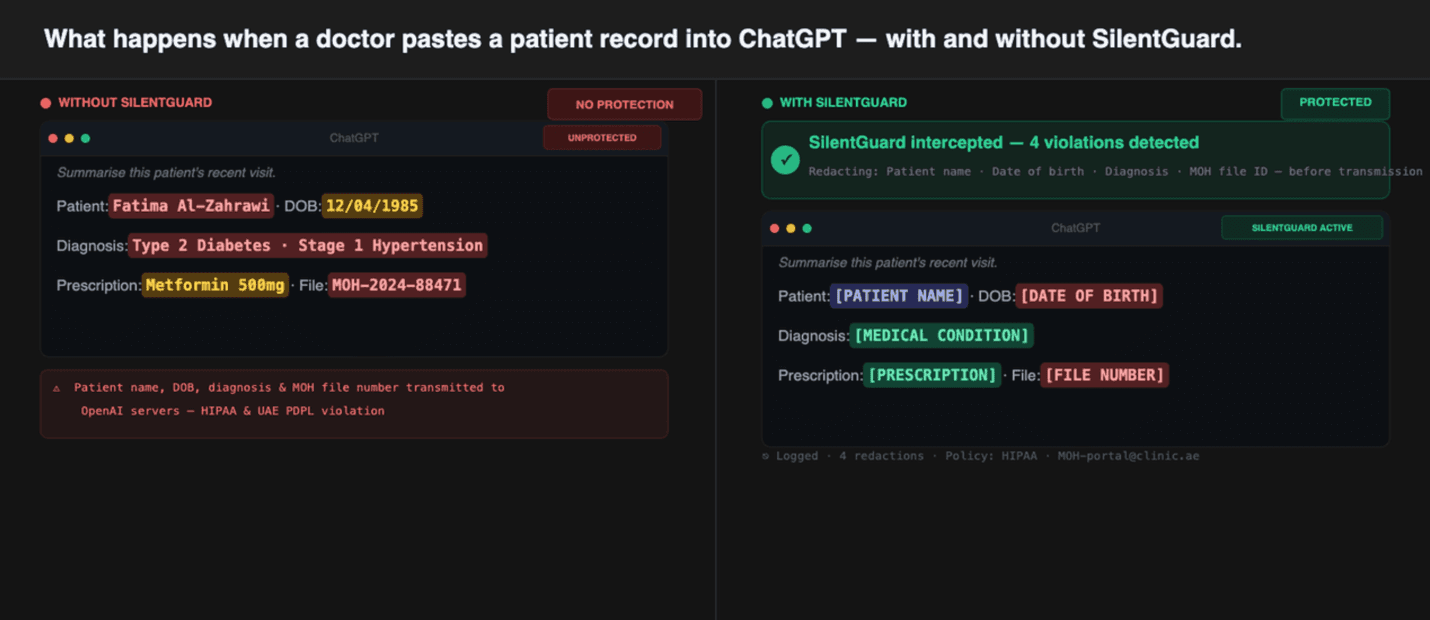
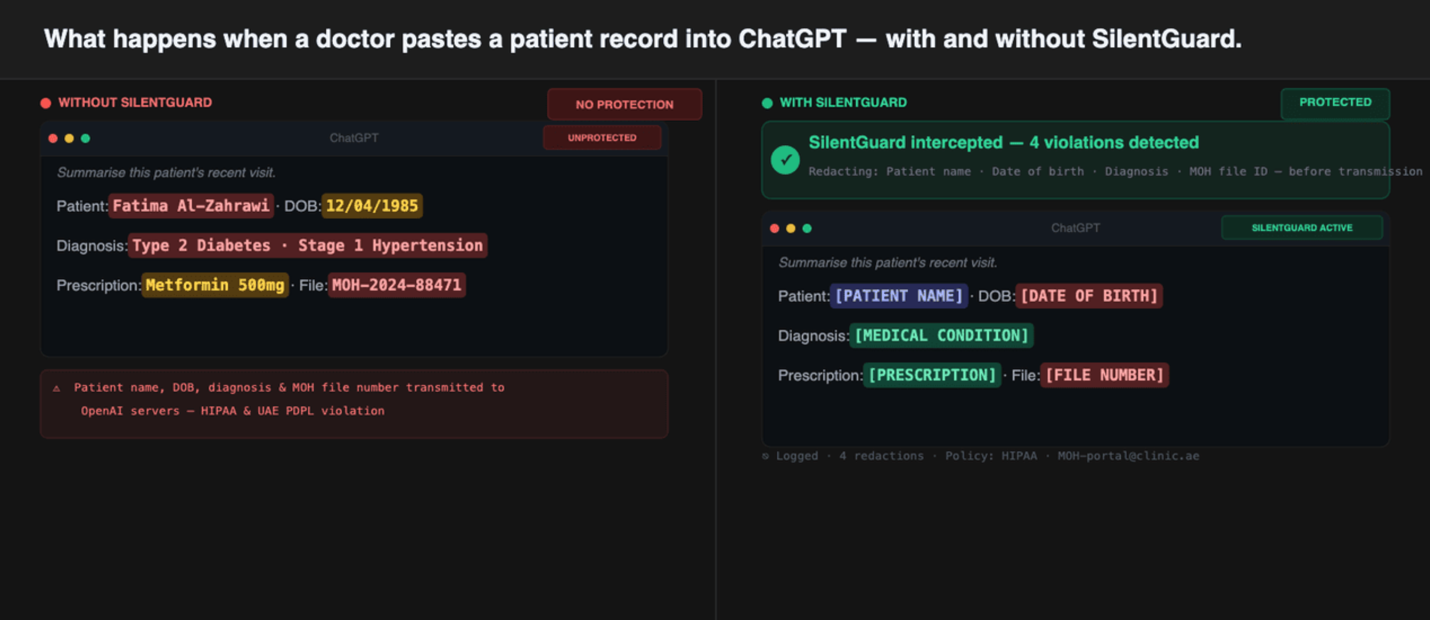
SilentGuard was designed specifically for this challenge. Operating directly on the browser, SilentGuard sits between employees and more than 650 AI platforms, analyzing prompts before they are submitted. Using pattern matching techniques alongside a local language model, the platform evaluates content in real time to identify sensitive information such as personally identifiable information, proprietary source code, financial data, customer records, and other protected business information.
When a prompt violates organizational policy, the submission can be blocked before the data reaches the AI provider. Because analysis occurs locally, sensitive information remains within the organization's environment rather than being transmitted elsewhere for inspection. Every blocked or flagged interaction is recorded, providing compliance and security teams with the evidence needed to support governance requirements, investigations, and audit readiness.
This approach closes the prevention gap that many organizations face today. Rather than discovering a problem after information has already been shared, organizations gain the ability to stop data exposure at the point where it matters most: before the prompt reaches the AI model.
Conclusion
While 77% of company data flows to AI tools daily, only 12% of companies can actually track that usage.
The conversation around AI often focuses on what these technologies can do. An equally important question is whether organizations can control what information reaches them.
Every prompt submitted to an AI platform represents an opportunity for business information to move beyond traditional organizational boundaries. As AI adoption continues to expand, relying solely on policies, training, or retrospective monitoring is becoming increasingly difficult.
Organizations that successfully adopt AI at scale will be those that combine productivity with preventative controls. They will understand not only how AI is being used, but also how sensitive information is protected before it leaves their environment.
Book a demo with SilentGuard to learn how to leverage real-time AI leak prevention across 650 platforms without sacrificing productivity.
Secure your AI workflows today
Learn how SilentGuard can protect your enterprise from data leakage without slowing down your teams.